Harnessing Biology to Drive Next-Generation Data Storage
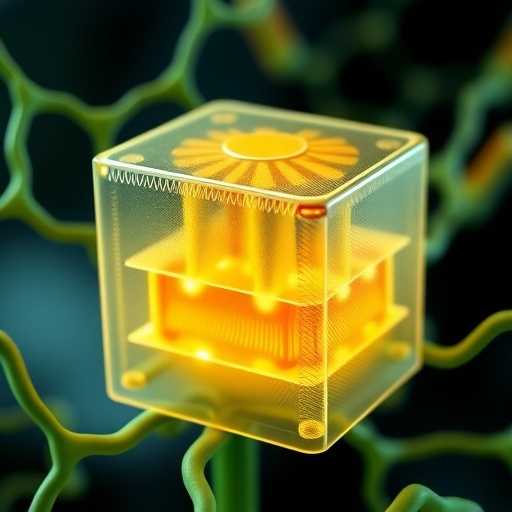
In a groundbreaking advancement at the intersection of biology and electronics, researchers at Penn State University have developed an innovative memory device that harnesses the exceptional storage capabilities of synthetic DNA integrated with quasi-two-dimensional perovskite semiconductors. This biohybrid approach promises to revolutionize low-power memory technology, offering an ultra-efficient pathway for future electronics, artificial intelligence, and neuromorphic computing systems.
DNA, the biological blueprint of life, has long been recognized as nature’s most efficient data storage molecule. Its astounding capacity to hold approximately 215 million gigabytes of data per gram far outstrips conventional storage media like flash drives or hard disks. Translating this vast biological storage potential to electronic data systems has remained a formidable challenge due to the incompatibility between biological macromolecules and inorganic electronic materials. The team at Penn State, spearheaded by Kavya S. Keremane and Bed Poudel, has surmounted this hurdle by ingeniously integrating synthetic DNA sequences with crystalline perovskite, a semiconducting material conventionally employed in solar cells and data storage.
The core innovation lies in designing a memristor—a memory resistor that can retain information even when powered off—constructed from this hybrid biomaterial framework. Unlike traditional resistors which hold a fixed resistance and erase data once the power is removed, memristors mimic the plasticity of neuronal synapses in the brain by remembering electrical states and facilitating dynamic current flow. This capability underpins neuromorphic computing, where data storage and processing occur simultaneously within the same physical locale, enabling faster and more energy-efficient computation.
What sets this work apart is the utilization of chemically engineered synthetic DNA oligomers, meticulously crafted to precise sequence lengths and compositions to suit electronic device requirements. Unlike natural DNA’s long entangled strands, these short, rigid synthetic fragments enable nanoscale architectural precision. Through a process called doping, the researchers embedded silver nanoparticles onto the synthetic DNA, enhancing its electrical conductivity and aligning its molecular units coherently. This molecular engineering effectively transforms DNA from a biological macromolecule into a programmable nanoscale electronic conductor.
Complementing the doped synthetic DNA is the quasi-two-dimensional perovskite layer, which interfaces seamlessly with the modified biomolecules and facilitates reliable electron transport channels. The synergy between these materials culminates in a biohybrid memristor that operates at ultra-low voltages—less than 0.1 volts—significantly lower than typical household electrical outlets. Remarkably, this device consumes 100 times less power than equivalent traditional memory storage systems while delivering superior storage density, representing a major leap towards energy-efficient electronics.
The team rigorously tested device stability, demonstrating reliable operation across extended temperature ranges up to nearly 250 degrees Fahrenheit, and continuous function over six weeks at room temperature. These performance benchmarks considerably exceed those of existing perovskite-based memory technologies, showcasing the robustness imparted by the molecularly engineered DNA-perovskite hybrid. This stability combined with the low power consumption promises new possibilities for scalable, sustainable memory devices needed for the surging demands of artificial intelligence workloads.
Moreover, this research offers a compelling blueprint for future bioelectronics, where biological motifs such as DNA are repurposed beyond their natural role into programmable, multifunctional nanomaterials platforms. As Neela H. Yennawar explains, computational design permits the modular tailoring of DNA sequences to achieve precise structural order and tunable electronic properties, capabilities unattainable with native DNA strands. This rational synthesis and systematic doping unlock unprecedented control over nanoscale interfaces and device functionalities.
As artificial intelligence and neuromorphic computing technologies continue to evolve, such low-power, high-density memory devices will be critical in enabling hardware capable of handling complex, multifaceted data inputs akin to synaptic processing in the human brain. Bed Poudel emphasizes that requiring less energy for increased storage defies conventional trade-offs in electronics, underscoring the transformative potential of this biohybrid approach in shaping next-generation smart computing architectures.
Looking ahead, the researchers aim to refine the bio-inspired design strategies developed in this work and explore broader applications in electronic devices that leverage programmable biological components. This approach calls to nature’s wisdom — employing evolutionary-optimized molecules like DNA not just as inspiration but as integral components of advanced electronics. The convergence of materials science, synthetic biology, and electrical engineering as demonstrated in this study opens vistas for a new paradigm in sustainable, high-performance information technologies.
This pioneering research, supported by funding from the U.S. National Science Foundation, National Institutes of Health, and collaborative efforts across Penn State and the University of Minnesota, heralds a new era in molecularly engineered memory devices. By bridging the immense data storage potential of DNA with the excellent charge transport properties of perovskite semiconductors, the team has redefined the boundaries of electronic memory technology, offering a glimpse into a future where biohybrid electronics redefine computation.
Subject of Research: Experimental development of low-power memristors integrating synthetic DNA and quasi-2D perovskite semiconductors.
Article Title: Molecularly Engineered Highly Stable Memristors with Ultra-Low Operational Voltage: Integrating Synthetic DNA with Quasi-2D Perovskites
News Publication Date: January 19, 2026
Web References: http://dx.doi.org/10.1002/adfm.202530539
References: Keremane, K. S., et al., Advanced Functional Materials, DOI: 10.1002/adfm.202530539, 2026.
Image Credits: Bed Poudel/Penn State
Keywords: DNA information storage, Synthetic biology, Biohybrid electronics, Memristors, Quasi-2D perovskite, Neuromorphic computing, Low-power memory devices, Molecular engineering, Nanotechnology, Energy-efficient electronics
Tags: artificial intelligence memory solutionsbiohybrid memory devicesbiological macromolecules in electronicsDNA-based memristorslow-power memory technologymemristor technology advancementsneuromorphic computing hardwarenext-generation data storage innovationsPenn State DNA electronics researchperovskite semiconductor applicationsquasi-two-dimensional perovskite materialssynthetic DNA data storage