Curiosity-driven scientist: My journey in bridging material and biology
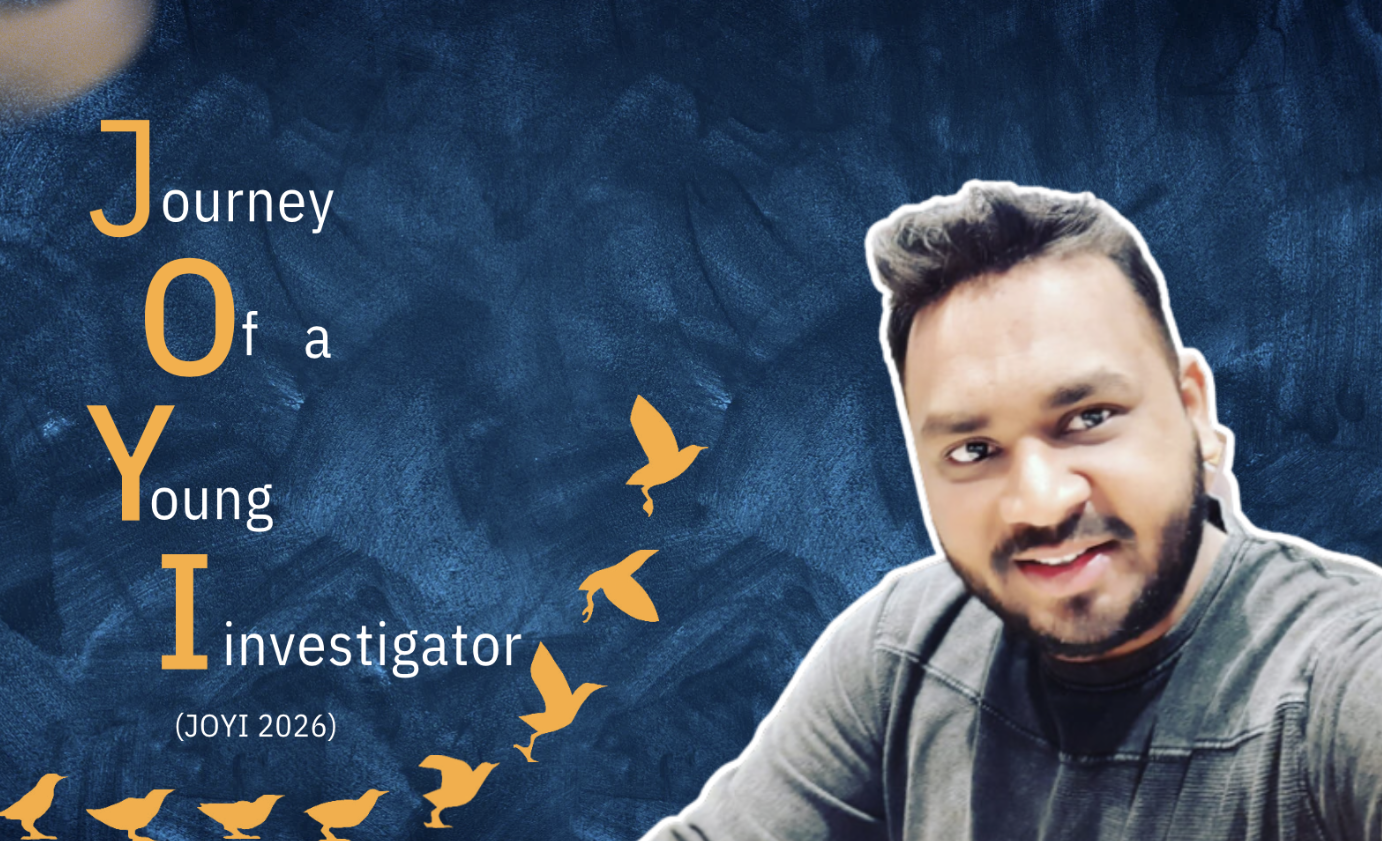
In this Journey of a Young Investigator (JOYI) 2026 article, Pranav Tiwari traces his journey from early curiosity about quantum science to leading interdisciplinary nanobiotechnology research. Navigating systemic barriers, global training, and personal setbacks, his path reflects resilience, scientific ownership, and a commitment to bridging materials science with biology to address real-world health challenges.
Curiosity sparks a scientific journey
My journey began with a fascination for quantum mechanics, which came through the book Quantum mystery and that curiosity led me to join the Nanotechnology degree program (Integrated MTech) at the Central University of Jharkhand. At the time, nanotechnology was a buzzword that few truly understood. Since I was in the first batch for this program, we had limited lab facilities but the theory courses were very diverse and covered basic chemistry and physics, along with courses related to biology and material science. Luckily, I was trained through a highly interdisciplinary syllabus.
Among these theory courses, I studied nanobiotechnology and DNA nanotechnology, where I was introduced to the idea of nanobots and their potential to transform healthcare applications. This interdisciplinary foundation became my greatest asset, though I did not yet know it would also become my greatest professional hurdle.
Finding direction through mentorship and research exposure
During my undergraduate days, I got the chance to do my internship and final year project at CSIR-National Metallurgical Laboratory (CSIR-NML), Jamshedpur under the mentorship of the late Suprabha Nayar. I was fortunate to work under her, as she was the first person to truly trust my potential. She introduced me to biomimetics and biomineralisation. Under her mentorship, I didn’t just learn to handle analytical instruments; I learned the importance of scientific ownership. She encouraged me to present my thesis at international conferences, which fascinated me as at that time I was not fully aware of conferences.
While working there, I learnt about electrospinning and this helped in getting the project assistant position at the Indian Institute of Science Bangalore (IISc), Bengaluru under the mentorship of Shilpee Jain. At IISc, I expanded my research domain and I also learned about the in vitro cell culture techniques. I integrated my work on electrospun magnetic nanofibers for hyperthermia applications. My main focus at IISs was to learn different analytical techniques, and within 10 months I submitted my first-ever research article as a lead author from IISs and then joined the Indian Institute of Technology, Indore (IIT Indore) for my PhD in the Center for Material Science and Engineering which later became Metallurgical Engineering and Materials Science department.
Those early exposures shaped my confidence and made research feel less intimidating and more meaningful. My doctoral work focused on carbon-based nanomaterials for optical biosensing, protein – nanomaterial interactions, and cellular applications. While the technical details evolved over time, the central theme remained constant — understanding how materials behave in biological environments and how we explore different nanomaterials for biological applications.
People often say a PhD is frustrating and depressing, but in my case, I enjoyed my PhD days all thanks to Indore, the food capital of India, and my friends. During my PhD apart from research, I was actively involved in student mentoring, grant writing, instrumentation purchasing, and lab management. These experiences quietly prepared me for the academic journey ahead.
Pandemic pause and recalibrating research goals
The COVID-19 pandemic disrupted many plans, including the timely completion of my PhD viva. During this uncertain period, I continued in the same laboratory as a research associate, which allowed me to consolidate my work and reflect on my future direction. I had already decided that my postdoctoral training should fill a critical gap in my skill set — molecular biology. I wanted to better understand how materials influence biological systems at a mechanistic level.
This decision took me to the United States for postdoctoral research. I initially joined the University of Notre Dame, but my time there was short and challenging. I moved to the University of Texas Rio Grande Valley (UTRGV) in the school of medicine under the mentorship of Murali Yallapu. My postdoctoral research focused on integrating chiral nanomaterials with cancer systems using molecular biology tools and animal models. This phase finally allowed me to bridge materials science with biology in a way I had long envisioned.
Returning to India: Building independent research in nanobiotechnology
During my tenure there, I was awarded the DST INSPIRE Faculty Fellowship. At the same time, a growing desire to return home led me back to India. I joined Indian Institute of Technology, Kanpur (IIT Kanpur) to initiate my INSPIRE project on chiral nanomaterial-based theranostic strategies for protein aggregation-related diseases. After a year, I moved to VIT Vellore as an assistant professor in the Centre for Nanobiotechnology.
Here, I now lead the HOPE lab (Healthcare Oriented Platform Excellence) and actively mentor PhD and master’s students while exploring chiral nanosystems for healthcare and environmental applications, and independently running two research grants from ANRF and DST. Our central research idea is simple yet ambitious: to investigate chirality as a biorecognition element beyond traditional antibodies and aptamers.
Teaching, mentoring, and building future scientists
I also greatly enjoy teaching biotechnology courses at VIT, as teaching helps me understand ideas more deeply. Alongside research, it strengthens my belief that good research starts with a strong subject area.
If I have to sum up my journey, it started with a simple desire to become a scientist and pursue a PhDbecause I saw scientists as “rock stars” who drive innovation and design future technologies.
After Class 12, I was certain that I wanted a career in research. My curiosity about quantum phenomena drew me toward nanotechnology, and my fascination with nanobots pushed me to integrate the material and biological worlds..
Even my current research on chiral material is based on curiosity — we still do not fully understand how life developed handedness (chirality), and amino acids and nucleic acids are prime examples..
One major obstacle I faced — and still face — is that the Indian academic system can be perception-driven. Coming from an interdisciplinary nanotechnology degree, many government institutes rejected my applications despite advocating interdisciplinary education. Although Vellore Institute of Technology (VIT, Vellore) gave me an opportunity, there were times I felt my nanotechnology degree was treated like a liability rather than a strength.
Even as we move toward the new education policy, there remains an obsession with “specific degree titles” or “backing from big names.” There were moments when my degree felt like a limitation instead of an asset.
Personal resilience and defining success on one’s own terms
Another major challenge was my stint at the University of Notre Dame, particularly due to loneliness and systemic neglect from my mentor. Yet these experiences strengthened my resolve to define my own path rather than wait for validation.
A key lesson from my journey is the importance of scientific ownership. Designing my own research questions and taking responsibility for outcomes has been deeply empowering. My interdisciplinary training allows me to approach problems with flexibility and confidence.
Throughout this journey, my wife Anuradha has been a pillar of support — helping me navigate frustrations and academic insecurities with calmness, good food, and unwavering belief in me.
Lessons from setbacks
I believe everyone has their own journey. As Sandeep Mashewari said, “Success comes from experience, and experience comes from bad experiences”. I have had my share of difficult moments, but clarity of purpose requires courage, determination, and patience.
Interestingly, the ideas behind the three research projects I lead today were born during my difficult months at Notre Dame. This proves that ideas matter, and persistent effort can bring them to life.
Overall, my journey reflects three core truths: interdisciplinary curiosity overcomes limited resources; pivoting is strategic, not a setback; and scientific independence comes from clarity, courage, and curiosity.
Lastly, during my time at IISc, I read a quote that stayed with me: “Science is long and life is short, We all are working together to improve the ratio”. This is a philosophy I hope to follow throughout my life.